
Background
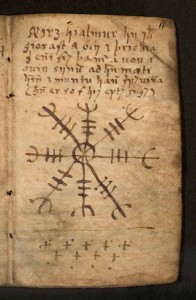
The Helm of Awe is a magical sigil said to empower and protect those who wear it. Indeed, its eight arms that radiate out from the central circle are very reminiscent of the algiz rune, which means “elk” and its shape is reminiscent of the animal’s antlers. Like the elk’s antlers, the rune signifies “protection or defense” and triumphing over one’s enemies. The forked barrier that the arms form present a formidable defense from hostile forces from all sides.
In Stanza 16 of the Fáfnismál (Fáfnir’s sayings) in the Poetic Edda, Fáfnir, a dwarf who has turned himself into a dragon, regards it as the source of his seeming invincibility:
The Helm of Awe
I wore before the sons of men
In defense of my treasure;
Amongst all, I alone was strong,
I thought to myself,
For I found no power a match for my own.
In the Völsunga Saga, after Sigurd slays Fafnir, he takes the Helm of Awe from the dragon’s hoard.
In a much later collection of Icelandic Folk Magic from the 19th century, The Galdrabók: An Icelandic Grimoire, there is a spell called “A Simple Helm of Awe Working”. That goes as follows:
Make a helm of awe in lead,
press the lead sign between the eyebrows,
and speak the formula:

Ægishjálm er ég ber milli brúna mér!
I bear the helm of awe between my brows!

Thus a man could meet his enemies
and be sure of victory.
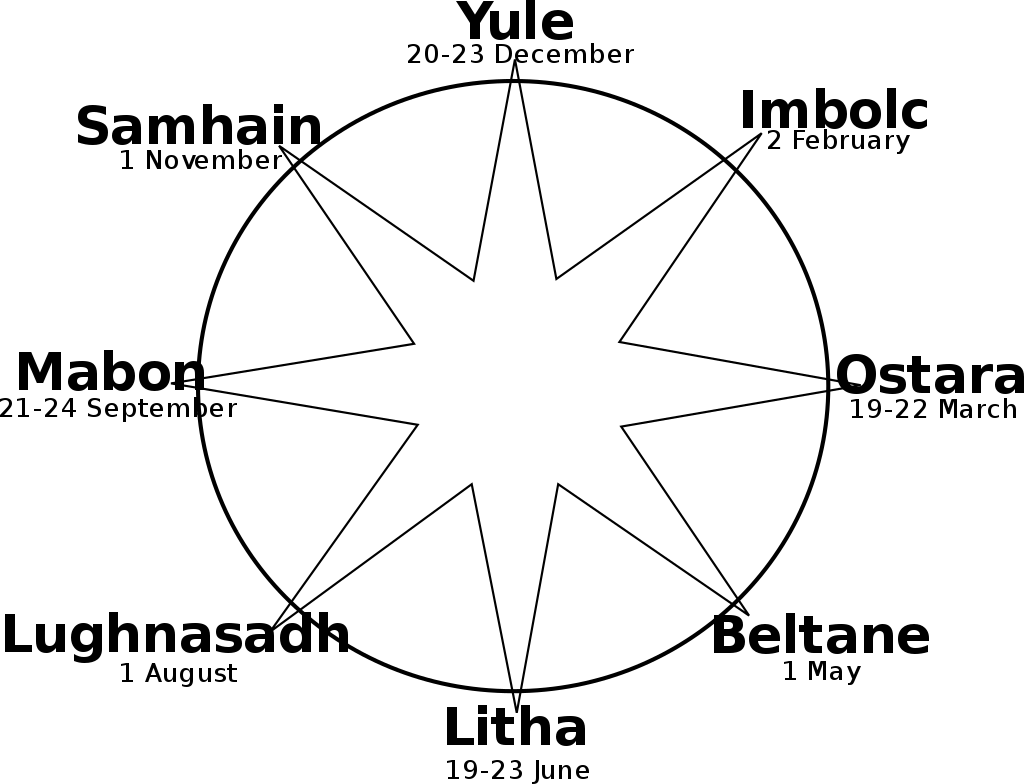
It should be noted that the Helm of Awe sigil as found in the Icelandic Grimoire may actually have been borrowed from other European magical systems and texts. There are no known instances of Viking Age artifacts that bear the design of the sigil. Nonetheless, with it’s Nordic associations, it serves as an apt depiction of the Wheel of the Year.
The Ritual
The inspiration for The Helm of Awe Ritual is something that came to me while contemplating the sigil and the texts. In my minds-eye I saw the Helm and layered beneath it were wheeled symbols from other spiritual traditions, adding a depth of meaning and forming an integrated whole.
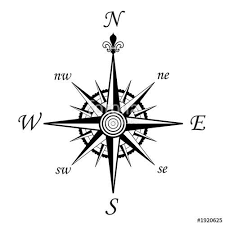
The ritual involves gathering 8 people, one stationed in each of the 8 directions that the Helm points to, for the purpose of invoking the energies of the directions and channeling them to a specific purpose.
In this era of cultural integration, we have the benefit of combining truths from diverse spiritual traditions to form a deeper, more holistic understanding. Thus, the significance of wheeled symbols from other spiritual traditions are incorporated into the Helm of Awe ritual to inform the ritual, but all are interpreted through the significance of the sigil itself.
The ritual incorporates accessing the energies of multiple cycles, all of which have correspondences with each other:
8 phases of the Directional Cycle
8 phases of the Earth's Holy Day Cycle
8 phases of the Daily Cycle
8 phases of the Seasonal Cycle
8 phases of the Biological Cycle
8 phases of the Agricultural Cycle
8 phases of the Psychological Cycle
8 phases of the Manifestation Cycle
From the Celtic Wheel of the Year, with its celebration of the Solstices, Equinoxes and Cross-Quarter days, we gain insights into the earth’s holy days
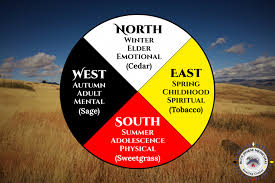
From the Native American tradition of the Medicine Wheel, we gain insight into the significance of the directions, spirit animals, and self-empowerment.
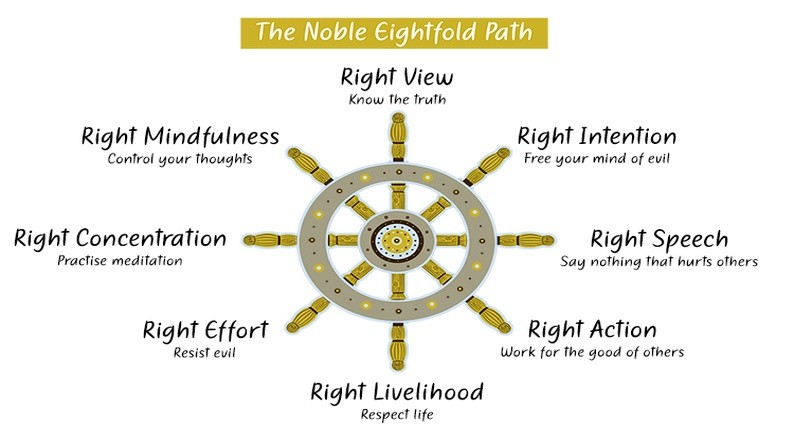
From Buddhism comes the DharmaChakra, the dharma wheel, from which we learn the tenets Noble Eight-fold Path, the pathway to enlightenment:
Right View
Right Intention
Right Speech
Right Action
Right Livelihood
Right Effort
Right Concentration
Right Mindfulness
Lastly, from Hindu mysticism comes the concept of “the Third Eye” that resides in the center of the forehead and is the gateway to higher consciousness. Certainly the folklore of pressing the Helm of Awe between one’s brows to be empowered by it is very suggestive of altering one’s consciousness. And this is the intended culmination of The Helm of Awe Ritual – to walk the Wheel of the Year in the quest for alignment with the Earth energies and self-empowerment.
 The Tribe of Scandia